Wednesday, November 30, 2005

The Word Is Near


On the Christian calendar, today is the feast of St. Andrew. Andrew was one of Jesus's twelve apostles, and an active missionary during the early years of the Christian church. As it happens, he is the patron saint of my parish church--and one of the patrons of fishermen, which I didn't know when we began attending. Is it mere coincidence that I ended up in my present parish?

I probably shouldn’t be too quick to assume an affinity with Andrew just because I fish. My rector used to serve at a parish on the Maine coast, where many in his congregation were working commercial fishermen (like Andrew). In the first St. Andrew's day sermon I heard him preach, he talked up the ruggedness and stamina of these commercial fishers at the expense of recreational anglers, who, he said, "just sit in a boat drinking beer all day." Honestly, I was a bit offended. I hardly ever fish from a boat.

But seriously, Andrew is one of my favorite religious figures, and not because of his piscatorial associations. This is in spite of the fact that we know relatively little about him. In the gospels, he doesn't speak very often, and is seldom even mentioned, in contrast to his showboat brother, Peter. He's a low-key, workaday guy, which is precisely what's important about him.

Andrew and Peter (or in some accounts, just Andrew) met Jesus while tossing a net in the Sea of Galilee , going about their work like they did most other days. But that meeting gave their lives (along with many others') a meaning and a direction they couldn't have forseen. His example suggests that it is within the ordinary that we find the extraordinary; that in common experience we may find what is truly meaningful and wonderful in life. Many of history's sages are in agreement with that, and I think the idea holds up whether you want to associate it with God or not.

It is a message I could pay more attention to, especially when I'm at work, or slogging through some of the less pleasant aspects of domestic life. I'll admit I attend to these things grudgingly much of the time, but I believe, at some level, that they too might bring some meaning or fulfillment if I gave them more care and concern, if I would take them up willingly instead of resenting their intrusion on something more immediately gratifying. What might Andrew have missed if he'd blown off fishing that day to take a walk? What if he'd shut that insistent street preacher out of his mind with daydreams?

I'm the last person who will suggest we ought to banish all hedonism from our lives, or devote ourselves to a miserable routine in hopes of some inchoate enlightenment down the road. I think we all need a plunge into the exotic now and then. But since we're going to spend the bulk of our lives in the quotidian, it makes sense to keep our eyes and our minds open while we're there. To be open to what possibilities it may offer, instead of allowing fatigue or boredom to shut them out entirely. To remember that behind the drone of routine, "the word is very near" (as a passage from Deuteronomy read today proclaims). And especially, when the extraordinary flashes out from the ordinary, to respond to it as wholeheartedly as Andrew.

Tag:

Monday, November 28, 2005

Sprucing Up

Kristine and I decided over the weekend that we're going to put up our first Christmas tree in at least 7 or 8 years. Since we moved to our current house, we just haven't been able to find room for one. But this year we figured we could squeeze a small tabletop model into a corner that recently opened up.

While I haven't missed a tree terribly, there are times I wish we had one, usually on Christmas day. Often we don't do a whole lot to celebrate, aside from cooking a big meal and going to church. In most years, I feel out of step with the season. I don't know that that needs to change, considering some of the excesses that come with the holidays, but a small effort at decorating might make the house a more pleasant place to spend some quiet, frosty nights.

I'm not going to be as hardcore about getting a tree as these people, although when I was growing up, my family always went the cut-your-own route. Mostly that resulted in hours of tramping though the snow at several different farms looking for a suitable tree, finally cutting one that was indistinguishable from most others we'd seen. My dislike of plantations full of cookie cutter pines long preceded any understanding of forest ecology. The greatest challenge Kristine and I will probably face is finding a tree small enough. Anybody seen midget trees for sale around Washtenaw county?

Sunday, November 27, 2005

Laying Low

Every have one of those weekends when you can't bring yourself to do much except eat, sip wine, read, and watch videos? When going out of the house sounds like too much effort? I'm wrapping up one of those. That mellow vibe I felt Wednesday has degenerated into full-blown sloth. I have gone out a couple of times (to buy wine, for a long walk Friday, and to jog yesterday), but that's about it.

I suppose I ought to be grateful that I have the space to chill out a bit, but having been raised with an expectation that every waking moment should be productive, I suffer guilt pangs about too much relaxation. Even about going fishing, sometimes.

But the lazy streak is at an end. Though the fog and cold rain outside aren't invigorating in the least, there are a few household chores that I can't put off any longer, and classes to prepare for tomorrow. Fortunately, I have put together some plans for class, albeit at a lesiurely pace. In my fiction class, for the last two weeks of the semester I'll be teaching Carl Hiassen's Double Whammy, a crime thriller set in the world of high stakes bass tournaments. Needless to say, making notes about that book has triggered some daydreams of floating around the edge of a lake on some midsummer night, casting a popper toward shore and listening for a small explosion in the darkness.

Tags: ;

Friday, November 25, 2005

Shopping For Jesus

As the holiday retail season gets underway, so does the Friend or Foe Christmas Campaign, an effort to identify and boycott retail chains that don't specifically identify Christmas in their advertising and marketing. Jerry Fallwell is the campaign's instigator, though similar efforts are being conducted by the Christian Educator's Association, Intl., and Don Wildmon's American Family Association. Earlier this week, I heard a commentator on a local Christian radio station endorsing these efforts as well. Supporters of the boycott claim to have the support of at least half a million consumers. Their sights are set primarily on Target, which they allege has banned the phrase "Merry Christmas" from advertising and in store promotions. Target denies the charge.

The boycotters argue that when stores refer generically to "holidays" or "celebration," they are discriminating against Christians. They may even be neglecting a civic duty. The Liberty Council, associated with Falwell, says that stores which "discriminate against Christmas" will receive a letter reminding them that "Christmas is Constitutional," as well as a federal holiday.

Quite a turnaround, this. As long as I can remember, and probably long before, Christians have bemoaned the commercialization of Christmas, the appropriation of the feast of the Incarnation to aid in the accumulation of filthee lucre. Now the problem seems to be that the commercial establishment is ignoring Christmas The moneychangers have quit the temple, and so goes forth the cry of the righteous.

In a way, the de-emphasis of Christmas by retailers has helped accomplish what those opposed to its commercialization wanted. The name of the holiday is associated less with manic purchasing (although the purchasing continues). But that troubles some Christians, who feel excluded or diminished somehow if they aren't given pride of place in the annual year end buying binge, and in every other corner of the public square. Shopping may well be the essential act of civic participation in today's America, so perhaps some feel that if the Kingdom of God isn't at the mall, it might as well be nowhere at all.

As I've understood Christianity and tried to practice it, public acknowledgement of either corporate or private faith is irrelevant. Christianity grew up on the fringes of society, and I think that is where it still flourishes. Demanding the endorsements of governments, schools, and businesses bespeaks a dangerous and overbearing pride, and those behind the Friend of Foe campaign ought to know as well as anyone where that leads. If they really want to see Christ honored in this holiday season, let them feed the hungry, tend the sick, and champion the neglected.

Tags: ; ;

Wednesday, November 23, 2005

Serenity. Now.

Getting our first really signficant snow of the year. The roads were a bit slippery this morning, and by noon, the salt trucks were in evidence.

I'm off for Thanksgiving break now, enjoying a breather after pretty hectic stretch of teaching. As both student and teacher, I've always enjoyed the pause of Thanksgiving and Christmas breaks, and not only because I'm off work for a few days. For some reason, this feeling of rest and peace comes over me at these times that I rarely have otherwise. I don't have similar feelings about the onset of spring or summer breaks, much as I may enjoy them. What I feel now may be the satisfaction of concluding a long labor, whereas in the spring, I feel grateful simply to have survived one. Also in spring, the rebirth of the landscape AND preparations for fishing season are underway, giving a sense of beginning rather than ending something. At the moment, I may be infected by the stillness of the oncoming winter; I do feel a pleasant congruence between the falling snow, and something in my mind.

I often think of Robert Frost's poem "After Apple Picking" at these junctures.

MY long two-pointed ladder’s sticking through a tree
Toward heaven still,
And there’s a barrel that I didn’t fill
Beside it, and there may be two or three
Apples I didn’t pick upon some bough.         
But I am done with apple-picking now.
Essence of winter sleep is on the night,
The scent of apples: I am drowsing off.
I cannot rub the strangeness from my sight
I got from looking through a pane of glass         
I skimmed this morning from the drinking trough
And held against the world of hoary grass.
It melted, and I let it fall and break.
But I was well
Upon my way to sleep before it fell...


Hope everyone finds a bit of rest over the holiday. For those not celebrating American Thanksgiving, I hope you find it where you can.

Tuesday, November 22, 2005

Read in Tooth and Claw

Australian environmental philosopher Val Plumwood was attacked by a crocodile while canoeing through a national park in Australia about 20 years ago. She survived, but sustained grave injuries. I recently found a link to an article she published about the experience in 2002. She tells a riveting story, interspersed with reflections about the place of humans in nature and the frameworks of understanding through which we view predation and our own eating habits. The piece gets a little theoretical at points, but even those points are accessible and provocative.
I think the article makes a nice appetizer for the mind prior to our annual expression of gratitude via gluttony.

Tags:; ;

Sunday, November 20, 2005

Fun with Rodents


Yesterday I was in a bird feeding supplies store looking for a squirrel baffle for our feeder pole. Squirrels can climb our skinny, slick feeder pole with no problem whatsover and clean out our sunflower seed feeder in a matter of minutes, probably as much due to swinging around on the feeder trying to get a foothold as by actually eating from the feeder. No matter. Once they empty the feeder, they can return to the ground to eat whatever seeds fell.

As it happened, I was unable to find a baffle that would fit our pole, but I did hear an interesting remark from the sales clerk helping me: "Hard to believe there's an industry built around frustrating squirrels." It is, come to think of it. I noticed too that there were at least four or five different brands of baffle, all functioning in a slightly different way, which means there are also competing theories about how best to stymie the clever rodents.

So much energy and thought expended to assure that birdseed gets to its intended recipents. Of course, its nothing compared to people dreaming up and experimenting with all sorts of flies for catching trout. True, fishing is more complicated and practiced under a wide variety of conditions, though it may not be much more significant in the greater scheme of things.

Squirrel baffling is evolving into a mamalian analog to catch and release fishing. Among the selling points listed on the baffles' labels is the fun one can have watching the squirrel perform unintentional acrobatics as it tries to circumvent the barrier. You cause the creature some discomfort, take some pleasure from the experience, but ultimately let it go unharmed. No license required, and no closed seasons.

With trout season six months away, I guess I need to find a baffle and get in on the fun.

Tag:

Saturday, November 19, 2005

Book Review: Being, Nothingness, and Fly Fishing, by Michael Checchio

Michael Checchio's mission in Being, Nothingness, and Fly Fishing is to recount "How one man gave up everything to fish the fabled waters of the West" while avoiding the snares of cliché that litter the corpus of fly fishing literature. Checchio is acutely aware of the tendency some fishing writers have of lapsing into a sort of mushy myticism about the unity of life, rivers as metaphors for the lifespan, divinity in the flash of a leaping salmon, etc. He even quotes reviews which lay such charges against fly fishing books, taking his title from the sarcastic suggestion of one reviewer that an author could not go wrong pitching a fly fishing manuscript called "Being, Nothingness, and Fly Fishing."

Checchio's appropriation of the title is, as he notes, ironic. No navel gazing or Worsdworthian hymns to the spiritual within the sensible for him. He does, naturally, describe beautiful rivers and he briefly considers the emotional satsifactions of fly fishing. Fishing, he writes, is "one means of perceiving the majesty of our planetary world. And no greater majesty can be available to the human senses." He conjectures that ultimately "fly fishers try to make a kind of healing connection with the world. Fishing lifts us above the ordinary, while keeping us connected to simple things." That's about as far into existential rumination as Checchio gets, and probably as far as most writers need to go.

In Checchio's previous life as a self-described hard-nosed street reporter, the Big Questions were never part of his beat anyway. His book tells the story of how he broke away from a secure but unsatisfying life as a journalist in New Jersey to chase trout and steelhead (mostly steelhead) full time. It follows him thorugh the initial summer of his getaway, hopping trout streams on the Yellowstone plateau (in the fiery summer of '88), venturing north to the summer steelhead rivers of Oregon and Washington, then settling in San Fransisco as a base for chasing steelhead and writing. In keeping with his reporter's background, the narrative pace is brisk, the detail spare but revealing. His adventures are peopled with distinctive characters, usually crusty and antisocial sorts (apparently some clichés of fishing books just can't be avoided--probably because their living inspirations can't). At his best, Checchio, like many American poets (William Carlos Williams comes to mind--what is it about New Jersey?) or Japanese Haiku artisits, conveys great depth of experience by describing the simplest of immediate, tangible things. When landing a memorable brown trout, for instance, he becomes "aware of several things at once. The feeling of living weight on the end of my line. The wind kicking up over the basin, wrinkling the surface of the river. One two three four small birds flying out of the willows." Writers who tie themselves in knots trying to evoke the sense of "connectedness" fishing brings on rarely succeed as well as Checchio does in this handful of sentence fragments.

But if simplicity is the book's main strength, it is also a weakness. Sluffing off his old life for trout bumhood doesn't seem to have been too difficult for the author. According to the subtitle, Checchio gave up everthing to fish the west. "Everything" apparently includes a job he had lost interest in, a home in a toxic, degraded landscape, and mediocre fishing waters. No partner, no family, no strong friendships, nothing of any particular personal significance. And he had plenty of money saved to make the trip. There doesn't seem to have been much at stake in his choice to leave, aside from fulfillment of a fantasy--and a fantasy which is itself a cliché among fishermen (including ye humble reviewer). If there are no serious obstacles to fulfilling that fantasy, where's the story?

Checchio admirably avoids egocentric nature worship, but also delivers a tale without much moral, emotional or intellectual substance. Among the reasons he cites for leaving journalism was to grow as a writer, to create literature instead of copy. That's tougher to accomplish than quitting your job to go fishing. While BN&FF is a start in the right direction, most of the author's intended journey still lies ahead. Along the way, a little introspection, or a glimpse around the edge of those Big Questions, might not hurt him.

Tags:;

Friday, November 18, 2005

Reading Water

Today, MidCurrent linked to an article from the Charlottesville, VA Daily Progress on autumn fishing in the Appalachins. One passage in the article in particular stood out to me:

Arriving at Second Creek, we were not surprised to find the water low and clear. It was so clear, though, you could have read the stock reports from the Wall Street Journal in 4 feet of water without squinting.

There was something familiar about this, and it occurred to me that I might be observing a trend in how fishing writers gauge water clarity. In spare moments over the last couple days, I've been reading Michael Checchio's Being, Nothingness, and Fly Fishing (which is not nearly as pretentious as the title might lead one to believe). In an account of his first visit to Wyoming's Bechler river, Checcio observes to a companion that "[y]ou could read the New York Times in this water" (93).

For all I know, subaquatic legibility may be a well-established trope for describing the transparency of rivers. But it is one thats new to me. The eternal cliche for describing trout waters is "gin clear," though slightly tannic streams might be said to have "the color of scotch whiskey," or "a light scotch-and-soda tint." People also say rivers are treacly, smoky, or cloudy, which also happen to be adjectives applied to scotch whiskeys. Others (perhaps fishermen forced to go on the wagon, or writing under a cloud of hangover guilt), descibe waters as tea-colored, or glassy. Either way, we're still in the realm of beverages. Rivers running muddy will be compared to coffee-and-cream or chocolate milk. All these are handy and widely understood analogies, but I wonder if they don't also reflect fishermens' desires to commune more deeply with--to drink in--the habitat of their quarry? Or, to put it in more down to earth terms, to make the wilds seem a little more homely?

The legibility descriptions seem a bit more artificial, though they also suggest a nature-culture interface. And there is more congruence between rivers and newsprint than first appears. Fishing is very much a matter of information processing. Despite the fact that papermills negatively impact many streams, paper is a reconstitution of trees and water, along with other ingredients. (Could this be a reason why so many fly fishers compulsively read and write about their sport?) At any rate, I think there is room to develop this notion of rivers as reading lenses.

Articles in the Times or stock listings in the WSJ use very small type, and so rivers allowing you to read those would be streams of above average clarity (Bombay Saphire Gin clear, in the old parlance). Still, newspapers present stark black and white contrasts; to do justice to rivers of extraordinary clarity, you might have to invoke a murkier script: "That river was so clear you could have read the Dead Sea Scrolls in it." A combination of old and new tropes would also convey exceptional perspicacity: "the still, sunlit pool was so clear I could have read the health warning on a gin bottle at its bottom."

Suitable instruments for gauging murkier rivers would include USA Today or pizza coupons. One could say that a river flooded with spring snowmelt or the runoff from a summer cloudburst was "so muddy you couldn't have read the funny pages in it if you'd shined a freakin' spotlight on 'em." The possibilities for irony (and environmental education) are rich: "Once the paper company had clearcut the banks of my favorite river, it ran so cloudy I was forced to take my reading elsewhere."

*sigh* ...Obviously, I've had a long week.

Tags: ;

Thursday, November 17, 2005

A Teacher's View on Textbooks; Snow!

Textbooks are essentially holding tanks for lovely and fragile ideas which disintegrate upon release into the torpor of the classroom.

On a less despairing note, I'm enjoying the year's first snowfall. Big, soft flakes fluttering down and even sticking to the ground. I'm starting to think about cross-country skiing. Not that we'll get enough snow for that today, but when the first big blast of snow finally gets here (if it gets here), I'll be more than ready.


Tag:

Tuesday, November 15, 2005

One to Watch

From the AP:

Republicans Push More Logging

Republican state legislators are introducing bills aimed at boosting timber harvesting in state forests. The lawmakers announced the initiative at several news conferences around the state yesterday. They say the package will be introduced in the House and Senate in the next couple of weeks. One bill would make it harder for regulators to rule certain areas off-limits to logging. Another proposal offers tax incentives to encourage private owners to allow timber cutting on their land. Still another gives incentives to the forest products industry to invest and expand operations in Michigan.

I haven't seen the details of this yet, but it's obviously a matter of concern for anglers and others with a stake in the outdoors. Are riparian areas among those where restrictions will be lifted?

These measures will probably find supporters outside of the timber and paper industries. Hunters like to see cutting tbecause it creates more meadow and regenerating forest areas, which generally increase the food supply available to popular game animals (though not for some species that require mature forests with lots of dead or downed timber). As a bird hunter, I certainly like to see some areas like that (and there don't seem to be a shortage of them at present), but I don't want to see the state turned into a game farm, either.

I have no problem with responsible logging. But cutting that reduces forest diversity or harms waterways doesn't fall into that category. There also is the issue of expanding the network of logging roads. Those can seriously impact forest health, and there has been a trend recently toward closing and rehabilitating them.

How justifed such fears are remains to be seen. But I'll be watching.

Monday, November 14, 2005

The Rake's Progress

Three-fourths of the Earth's surface is water, and one-fourth is land.  It is quite clear that the good Lord intended us to spend triple the amount of time fishing as taking care of the lawn.  ~Chuck Clark

If there's any truth to that, I have a divine mandate for a full week of fall steelheading. Spend half of Friday and most of Saturday and Sunday raking leaves. Finished the job, but at the expense of some grading and other school chores hanging over my head. I'll be doing quite of bit of explaining to my students this week about why I haven't got what I promised them last week. Usually it's the other way around.

Worse things can come from raking, though. One of my neighbors is a fireman, and over the fence Sunday, he told me he'd been called out three times over the weekend to put out brush fires that started when burning leaf piles got out of control. At least I didn't burn down the neighborhood. And in all probability, my yard work for the year is done!

Sunday, November 13, 2005

Still Carping

Seems to be a carp weekend. Found the following joke at the site of a Chinese blogger. As far as I can tell, it's his first and only post. Great way to start, though.

 
Two fishermen were out on the lake when one of them dropped his wallet. As they watched the wallet float down to the depths of the lake, a carp came along and snatched up the wallet. Soon came another carp who stole it away and then a third joined in. Remarked one of the fisherman, "That's the first time I've ever seen carp-to-carp walleting."


Tags:;

Saturday, November 12, 2005

Giant Killers?


Voracious, 100 lb. Asian Bighead carp are working their way up the Illinois river and into the Chicago canal, knocking at the gates of Lake Michigan. These exotic fish farm ecapees consume two to three times their weight in plankton daily, wreaking havoc at the bottom of the food chain and, ultimately, thoughout the aquatic ecosystem. Who will save our beloved salmon, trout, perch, and bass fisheries?

Perhaps Carp Protein Products of Havana, Illinois. Go get 'em, boys.

Tags: ;

Friday, November 11, 2005

11/11/11/18


Growing up, I often thought my family was a little out of step. For instance, the rest of the country celebrated Veteran's Day on this date, and had since 1954. In our house, the holiday was still known as Armistice Day, the day for honoring veterans of World War I first observed in 1919 and established as a national holiday in 1938. My mother was the daughter of a doughboy, and so grew up with her father's recollections of the Great War, as World War I was then known, and with public remembrances of those who served in it. In one of these remembrances, the children in her school classes would all stand up at 11:00 AM on November 11 and silently face eastward for one minute, commemorating the signing of the armistice ending the war at that time and date in a railroad car at Compiègne, France.

Of course, before my mother was long into her teens, another, greater war came along. Congress eventually dedicated November 11th to remembering all veterans. The change is surely appropriate, though by shifting the focus from particular historical events to a kind of trans-historic heroic character, it makes obsolete the very focused rituals of remembrance that my mother knew. People no longer recall and re-enter a decisive moment, but think of those who have cycled in and out of wars over the centuries. I don't know if this is a gain or a loss, but in my house, it was beside the point. The day was still Armistice day, and at 11:00 on November 11th, my mother would stand and face the east for one minute. That's what she said anyway, and on the few occasions this date fell on a weekend when I was home from school, I saw her do it myself. And at least a couple times, I joined her. I wasn't quite sure what it was about, but I did sense that somewhere in the gesture was a family connection to history. Real history, like you read about, not the (usually unfortunate) history of remote and often deceased relatives told and retold during summer nights on my grandmother's porch.

My ideas of what history does and doesn't count have shifted a bit over the years. I wish I'd paid better attention to some of those family stories, or heard them when I was a bit older and might have understood them better. Beyond my parents, and very sketchy acquaintaince with my grandparents, I don't have much of a sense of my roots. While this lack isn't especially painful, it is there. So when I remember, or when I'm not busy with something I can't set aside, I try to take a minute at 11:00 on the 11th of November to face the east quietly. Not so much for reasons of war or peace or national pride, but to remember who I came from, and where, in time and place, they came from. An arcane private ritual, I'll admit, but as a fly fisherman, I'm predisposed to those anyway.

Tags: ;

Thursday, November 10, 2005

Wasteland (?)


Today, one of my students wore a T-shirt with the message "Ohio: Nothing to see since 1803." Unfortunately, it's just about the truth, at least in this part of the state. Of course, Ohio's taxpayers support me, so maybe I shouldn't poke fun.

Still, it's not altogether bereft of natural attractions. This region hosts a number of rare butterflies. It seems to be a haven for endangered wildflowers, too. Northwest Ohio doesn't offer much in the way of grandeur or picturesque appeal, but some it has some captivating minutae. I've met a few people with a deep knowledge of and attatchment to the area. I think their bond to this place bespeaks an admirable perceptive capacity.
;

Wednesday, November 09, 2005

Natural Talent

A couple days ago, I ran across the website for Project FLOW, a grade-school science curriculum developed by Michigan Sea Grant with lessons built around the ecology of the Great Lakes. Sounds like a neat course, but what stood out to me was one of the graphics at the site:

I liked it, and something about it looked very familiar. Then I remembered that an artist friend of mine works at Sea Grant as a graphic designer. I checked the credits, and there he was: Todd Marsee.

Todd is a former colleague of my wife's, and has been creating and selling though-provoking nature-inspired paintings for a number of years. I like his work because it steps outside the strict realism of most of the nature art that I see. It shows some serious thinking about how people relate to their environments, yet is representational enough for people with limited exposure to the visual arts (like me) to understand and appreciate. Todd has an online gallery; give it a visit.

Tuesday, November 08, 2005

A (nonfishing) Fishy Site

Thanks to computers, practically anyone can be an animator. Some evidence suggests this may not be such a good thing.

Monday, November 07, 2005

Four-Oh

Today is my 40th birthday. Spent a good deal of the weekend celebrating, actually. Kristine and I went out for a nice dinner and a movie Saturday; yesterday we met my sister and a friend of hers for lunch as they were passing though the area, and she laid a very tasty cake on me; last night Kristine cooked me a "special birthday dinner," and who knows, there might even be another one of those in the works.

I don't have any great remorse about the number itself. I don't feel that I'm abruptly losing something, or drastically changing somehow. But I am a little confused about what lies ahead. Some time ago, it occurred to me that I didn't know how to be middle aged. All I knew was being young, or at least what being young was at the time when I was young. My frame of reference remained that of a student or an aspiring young professional, despite racking up a marriage, a mortgage, and more than ten years of a teaching career. As the years went on, I could relate less and less to my students, yet I didn't feel much closer to my elders.

I have the notion that, in my parents' time, the paths for one's life were more clearly marked out. There was a certain condition of middle class responsibility and comfort you aspired to and settled into when you had the means and the stability. Youth prepared you for that. But today, it's often remarked that childhood, or adolescence, extends longer than it did a generation ago. Some of that may be due to economic necessity: people may require a longer period of dependence on their parents for support or shelter before establishing themselves. But some of it is because as people age, they want to carry their youth, or youthful interests, with them whether in the form of music, Disney cartoons, Hello Kitty gear, Xbox games, or whatever. Aging becomes a project of accomodating those habits and interests into new circumstances, of, in short, remaning hip. My parents, or any parents of my friends, were never encumbered with that concern.

And that's where it may go well for me. My purchase on hipness slipped away ages ago, and was never that firm to begin with. I may not know how to be middle aged, but I wasn't that great at being young either, at least if being young is about friendships, spontaneity, hedonism, and self-exploration. I got through youth by trial and error, improvising as I went along, and the results were usually tolerable. That strategy is a part of being young I can carry with me as I age. Honestly, I'm not sure what alternatives there are.

Sunday, November 06, 2005

Do They Ever Learn?

Among items in the news last week was the passage of a 2006 federal budget, approved in slightly differing versions by the House and Senate, and endorsed in large part by the Bush administration. It cuts a great deal of spending on social programs that help poorer Americans. It also includes tax cuts that will primarily benefit the well off. The budget bills approve oil drilling in Alaska's ANWAR refuge, with supporters offering the specious claim that it will reduce our dependence on foreign oil. What it will almost certainly do is line the pockets of some oil companies and their stockholders.

Included in the spending cuts are a $35,000,000,000 reduction in food stamps, besides cuts in Medicare spending and school lunch programs. In conference, the House may try to push the food stamp cuts higher.

In itself, this is no surprise from the Bush administration and the current congressional majority. With a few largely symbolic exceptions, they've always frowned upon social spending, despite being able to dig up the money for a pointless war and, in the case of the White House, expansive and agressive PR campaigns. What does surprise me is that this plan could pass mere weeks after Hurricane Katrina gruesomely laid bare the gap between haves and have nots in the country, and the greater vulnerability of the latter group in the face of disaster, or even in ordinary life. All these leaders saw the disturbing footage (albeit reluctantly in the president's case) and pledged concern and assistance. But since then, a deadly amnesia appears to have settled over Washington. Bush may have quit drinking years ago, but his short-term memory remains severely impaired.

In church this morning, our rector warned us that on Sunday the 19th, our church would be picketed by the Reverend Fred Phelps and his traveling homophobic freakshow. They're visiting us (and three other Ann Arbor churches) in conjuction with protesting a production of The Laramie Project at U of M. St. Paul argues that by showing one's adversaries kindness, one heaps burning coals on their head. In the case of Phelps I'd rather do the heaping literally, though he'd probably relish suffering for his cause. Which might have been what Paul was getting at. Anyway...grant us forbearance, Lord...

Saturday, November 05, 2005

November Olives; More links

Last night I had a 5:30 PM appointment in a building along the Huron river just downstream from the U-M hospital. I got there a bit early and walked down to the river to enjoy the unseasonably warm evening and autumn colors reflected in the quiet flow. Not a breath of wind moving. Ann Arbor's skyline stood out against a lemon twilight, shading into bands of orange and violet above.

Sometimes it's not easy to see how clear the Huron is. From a ways off, it usually appears dull, treacle brown or cloudy gray. But that's just because of dark silt on the river's bottom. People describe the water of many trout streams as "gin clear," and while the Huron is not quite that, it certainly is no more than a slight dash of lime juice or olive brine away from it. Looking straight down in the water, you can clearly make out rocks and drowned timber in the river, beds of gravel, trails of crayfish in the silt, or river grass swaying in the current. At this point in the year, that grass is turning a pale yellow, if it hasn't already shriveled to kinky brown filaments which will shortly come unmoored from their roots and drift along the river's bottom until they disintegrate, adding to the muck along the river's margins, or at the bottom of Gallup Pond.

The river's surface showed a few dimples of feeding fish--something I ordinarily wouldn't expect this time of year, though I suppose the recent warmth has kept the flies hatching and the fish looking up. A few caddis shivered over the water, but the quiet rises were probably from fish sipping emerging blue wing olives.

Some of the little mayflies hovered around head height. I caught one and inspected it for a moment, wondering if I shouldn't have gone fishing on Thursday instead of hunting. Letting him go, I started making plans to meet up with his progeny--and their predators--next fall. For the time being, I was grateful to share a moment the river and its inhabitants.

Found a few other interesting links.

Ontario Wanderer features nature photos and stories from rural Ontario and beyond.

A philosophy professor's lesson plan incorporates fly fishing into his discussion of Swedenborg. Where was this guy when I was in school? (another find from Midcurrent.)

Friday, November 04, 2005

Hey, I Just Got Here!; Grouse Hell

Sweetney foresees the end of blogging, or at least its fall from fashion. As she sees it, after peaking sometime early this year (surely because of the debut of FTR , heh heh), the phemonenon of blogging is losing steam, and may soon become the high-tech equivalent of a mullet. She may be on to something, as she seems far more immersed in the blogging world than I am.

No surprise, that the blogging bandwagon would go off a cliff just after I took my seat. I have a history of untimely beginnings. I started my IRA account in the summer of 99, which gave me a couple months to profit from the tech boom before losing massively. When I started work in publishing, the company president greeted my class of trainees with an announcement that the field was moving out of paper and ink and into the brave new world of computers. I think she meant that to be inspiring, but, fresh off a collegiate immersion in American Renaissance and Modernist literature, I felt profoundly cheated. Soon I went back to grad school, where I could indulge my bookworm tendencies.

Wherever this medium goes, I want to keep doing some kind of online, fish-oriented expression. I'll admit my sense of purpose sometimes falters between fishing reports. I'm still trying to hammer out a consistent blog identity. Hopefully I'll pull it together before it becomes a moot point.


Made another local hunt yesterday. I'm despairing of ever finding another game bird in southeast Michigan. In most years, migrating woodcock would be passing through now (or might already have moved further south), but the mild weather is keeping them up north. Yesterday, I worked the grousiest cover I've yet found around here, and turned up neither grouse nor signs of any. I know grouse can thrive in southern michigan--my dad and I used to move loads of them on a farm near Hastings, and occasionally a few in the woods outside our house--but they don't seem to reside within an hour of Ann Arbor. Am I missing some hotspot?

I drove home cursing this birdless, troutless place where I now live, but then I remembered what I have taken from my hunts. I've seen plants and trees I never thought existed in southern Michigan. I've stood at the edge of swamps half a mile wide, and seen strands of maples and oaks, fully fired in red and orange, stretching more than twice that long unbroken. I've walked from the edge of a busy road to places where the traffic sounds could barely compete with the wind in the pines. All less than one gallon of gas away.

A move to the north would be nice. For now, a shift in expectations might be enough to get by.

Oh, yesterday I also jumped a buck deer with a very large rack. Deer hunters, I'll be glad to disclose his location to whoever makes me the best cash offer. Submit bids in the Comments section.

Thursday, November 03, 2005

Blogs Across the Water

When I started writing FTR, I couldn't find many non-commercial fly-fishing oriented blogs out there. Many I did find seemed like they got updated about three times a year. But I am beginning to see more, many of which are quite well done. Today, I ran across Fly Fishing Journal, a site out of Singapore whose photos of lovely tropical fishes compensate for its bland title. The style is very factual and minimalist (no flights of introspection or evocative metaphors, let alone political rants, which might cause one some trouble in Singapore), but the love of the sport shines though anyway.

One of the reasons I liked this blog was because it expanded my horizons a bit. I always imagined Singapore (when it came to mind at all) as a tiny, crowded, built-over island with next to no outdoor opportunities. I stand corrected. I also got to see a tilapia prior to its being filleted, frozen, and sealed in plastic. Not unlike a bluegill. I will eat some meals with just a little bit more awareness and appreciation now.


This may be corny, but more than in most of my other web-surfing, visiting this site gave me a sense of the internet's vaunted ability to break down barriers of distance and culture. Music and binary code may be universal languages, but I suspect fishing is one too.

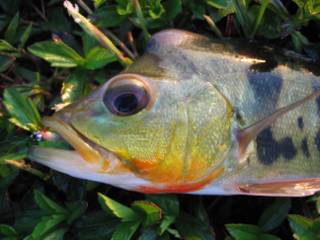
Among the fishes sought by Singaporean anglers are:

Earth Eaters (which sounds like an entity from some fantasy novel)--


Peacock Bass--


Should I ever find myself headed to Singapore, I think I'll pack my travel rod. And with FFJ's detailed instructions about how to catch these and other fishes, I'm confident that I could put a bend in it.

Wednesday, November 02, 2005

Teaching Dilemma; Raking; The Brewing Battle

Today I'm teaching Ray Carver's short story "Cathedral" in my Intro to Fiction class. It's one of my favorite short stories, but I'm pretty much drawing a blank about what to say about it. I'm also teaching John Updike's "A&P," which doesn't do much for me, but seems to offer a lot of fodder for discussion. It's not uncommon for me to find the books I most like to read are not the ones I find easiest to discuss, or to teach. You'd think it would be the other way around.
------------------------------------------
Most years, I'd be doing the last of my leaf-raking now. But the trees in and around my yard still have most of their leaves. Unusual.
-------------------------------------
Is it just me, or has Democratic oppostion to Bush's latest pick to SCOTUS been just a bit too reflexive? It appears all sides are marshalling forces for a battle royal, but is this the fight Democrats ought to pick? I get the impression many of them, in and out of office, are so eager to strike a blow against Bush that they'll hurl everything they have into anything that they can oppose him on. Some things ought to be fought tooth and nail, but if you go full tilt at everything, the act wears rather thin after a while. And the odds are, barring some kind of really shocking revelation of wrongdoing on Alito's part, he will be confirmed. And it's unlikely Bush is going to nominate someone to the liking of liberals. My suggestion to Democrats would be to take a wait and see approach to Judge Alito at first (too late), give him a sound grilling, give him a stern rebuke for not being forthcoming in his confirmation hearings (and he won't be), then let the vote go forward. They should throw their weight into opposing Bush's latest round of tax cuts.

A few liberal lawyers of my acquaintance suggest that Alito may not be the nightmare some are making him out to be. But the fight that appears to be looming over his confirmation will be a nightmare for the country as a whole.

Tuesday, November 01, 2005

While You Were Worrying about Iraq and Judge Alito...

If you were planning to go to Yellowstone Park (or any other NP), you'd better get there soon, or else...

-----
Total # of trick or treaters last night....0! We must be the scariest thing on the block.